Case Study: La psicóloga en casa Website
Where it started
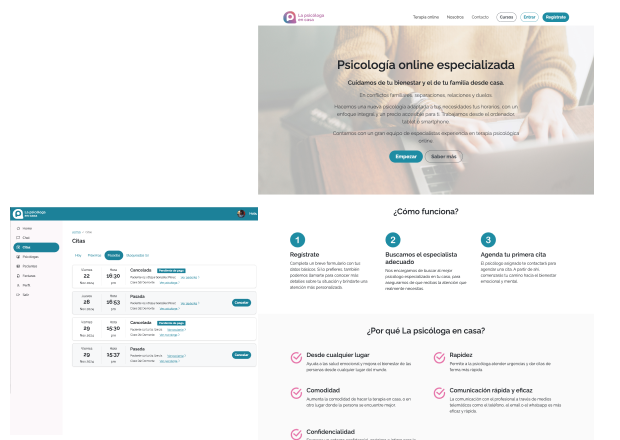
The starting idea was to use AI to match each patient with the specialist best placed to help them, with privacy built in from day one. Around the recommender, the project needed a complete platform: sign-up, payments and its own video call system, because therapy sessions couldn't rely on external tools.
The Challenge
Matching patients by hand works while there are only a few cases. As the platform grows, each match means reading the reason for the consultation, remembering what every psychologist specialises in and checking who has free slots. We wanted the AI to do that first pass and leave the decision with the person who knows the team.
How the recommender decides
Here's a made-up example. When signing up, someone writes that work has been making them anxious for months, they're struggling to sleep and they can only connect in the evenings.
The person explains in their own words why they're looking for help. We use free text instead of checkboxes because it captures nuances a list of options loses.
The platform sends that text to Gemini along with each psychologist's specialities and availability.
The model reads the text (in the example, anxiety and work-related stress with sleep problems) and compares it with each professional's areas. Among those who work with anxiety, it leaves out anyone with no evening slots.
It returns a short, ranked list with the 3 best-matched psychologists and the reason for each suggestion.
The coordinator reviews the list and chooses. She can go with the first option, another one on the list, or someone who isn't there at all if she knows something the system doesn't, like a psychologist who is about to stop taking new patients.
The patient never sees the AI's recommendation: they're simply assigned the psychologist the coordinator picks.
The criteria are speciality and availability. We didn't use collaborative filtering, which recommends based on what people with a similar profile chose. We explain why, and how to choose between approaches, in how to add a recommendation system to your product.
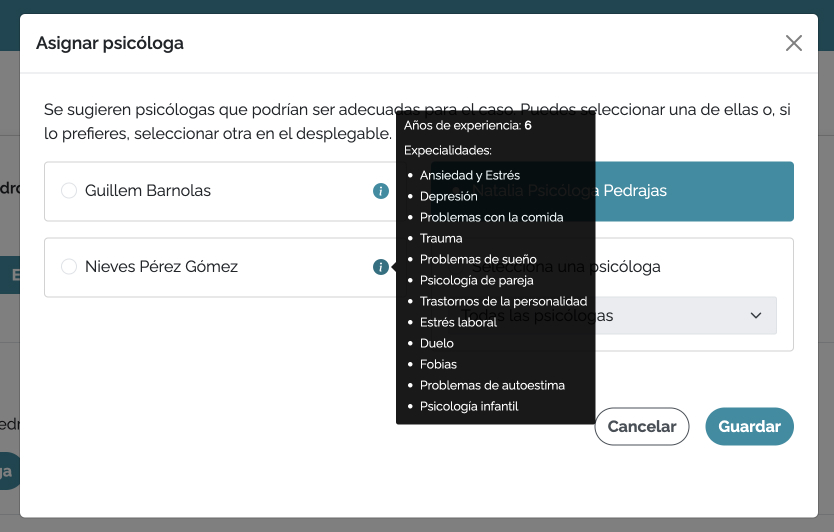
AI suggests the three best psychologists for the case.
What the AI doesn't do
It doesn't diagnose or assess how serious a case is. It doesn't talk to the patient or replace the first session, which is where the psychologist really gets to understand what each person needs. It doesn't assign anyone on its own either: it ranks the options so the coordinator can decide faster and with more information.
Having a person review every recommendation is something we ask of any system involved in sensitive decisions. We go into more detail in AI governance in companies without black boxes.
Privacy and health data
The reason for consultation is health data, one of the special categories protected by the GDPR, and we treat it that way:
The model only receives what it needs to make a suggestion: the reason for consultation and the professional profiles.
We use the paid enterprise version of Gemini on Google Cloud. Under Google Cloud's terms, data isn't used to train models without the customer's permission, and processing is covered by its data processing agreement with Standard Contractual Clauses.
- Video calls are encrypted.
Technologies We Used
Symfony. The PHP framework behind the whole platform: sign-up, profiles, scheduling and the matching flow.
Gemini. Google's model, which reads the reason for consultation and compares it with the psychologists' profiles.
Stripe. Handles session payments.
Built-in video calls. Encrypted sessions from any device.


Gemini
Gemini is an advanced artificial intelligence model from Google, designed to understand and generate text accurately, offering personalized solutions in multiple applications.

Stripe
Stripe is an online payments platform that allows you to manage transactions securely and efficiently. With its flexible API, you can integrate payments, subscriptions, and refunds into your apps or websites.
Results
Thanks to the integration of AI, the "psychologist at home" service has enabled patients to be assigned the most suitable psychologists for their case, improving therapy outcomes.
Secure video calls and a seamless experience have helped the platform quickly gain user trust.
We're still working with La Psicóloga en Casa on new features for the platform.
What if your business isn't about psychologists?
The same approach works anywhere you need to match a person with a professional and the request comes in their own words. A tutoring company could assign tutors based on what students say they struggle with and when they're free. A law firm could route enquiries from its website to lawyers by practice area and current workload. A maintenance company could send each call-out to a technician with the right skills and a free slot in that area.
What changes from one case to another is what describes each professional, which constraints matter (schedule, location, language) and who reviews the suggestion before it reaches the client. If you're considering something similar, our custom AI development page explains how we approach these projects.
Tell us about your case
If you need to match people with whoever is best placed to help them, tell us about it.